
Snapshots in Neuroscience: Fruit Fly Neurons
These images have been selected to showcase the art that neuroscience research can create.
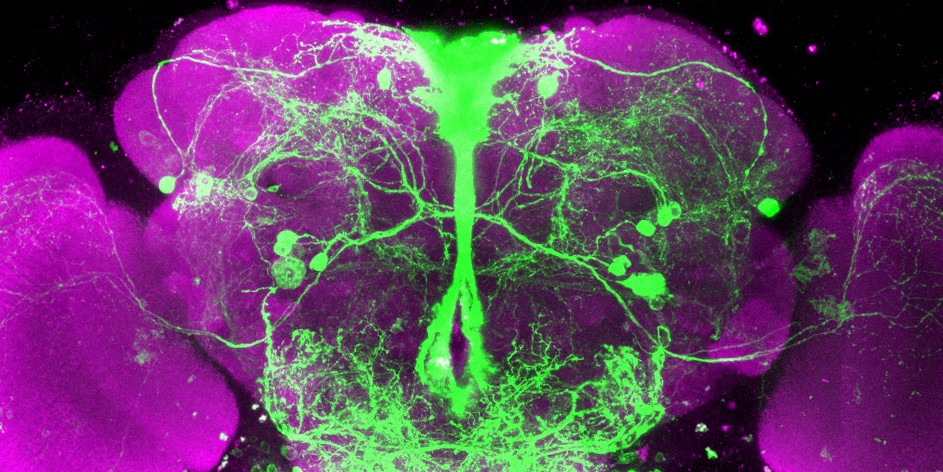
As described by the authors: “The image is of a whole adult male Drosophila (fruit fly) brain, with expression of membrane-tethered green fluorescent protein (GFP) in neurons that express the neuropeptide F receptor (NPFR) and detected with anti-GFP antibodies (green). Magenta is the ELKS/CAST presynaptic protein Bruchpilot that reveals the full synaptic neuropil.
“Neuropeptide Y (NPY) in vertebrates and its ortholog NPF in the fruit fly regulates hunger and thirst, inter-related and highly motivated internal states for distinct ingestive behaviors. To better define how motivational states are encoded, Orozco Ramirez and colleagues mapped where in the brain the receptor for NPF, NPFR, functions for thirsty water seeking. Using genetic intersectional techniques, anatomy, and behavior, they mapped NPFR function in thirsty seeking down to a single bilaterally symmetric neuron, termed the L1-l. The L1-l, activated by thirst, also regulates consolidation of long-term memory by removal of a negative valence interference signal. The authors speculate that thirst may drive water seeking in part by NPF regulation of ongoing valence through the activity of the L1-l neurons.
“This confocal image was taken with a 20x objective and optically sectioned at a 1.5 μm interval. The resulting 120 μm depth z-stack was transformed into a single plane image using maximum intensity compression.”
Read the full article:
A Single NPFR Neuropeptide F Receptor Neuron That Regulates Thirst Behaviors in Drosophila
Donnoban Orozco Ramirez, Brian P. Wang, Dan Landayan, Gagandeep Kaur, and Fred W. Wolf
FOLLOW US
 RSS Feed
POPULAR POSTS
TAGS
CATEGORIES